

Product brief
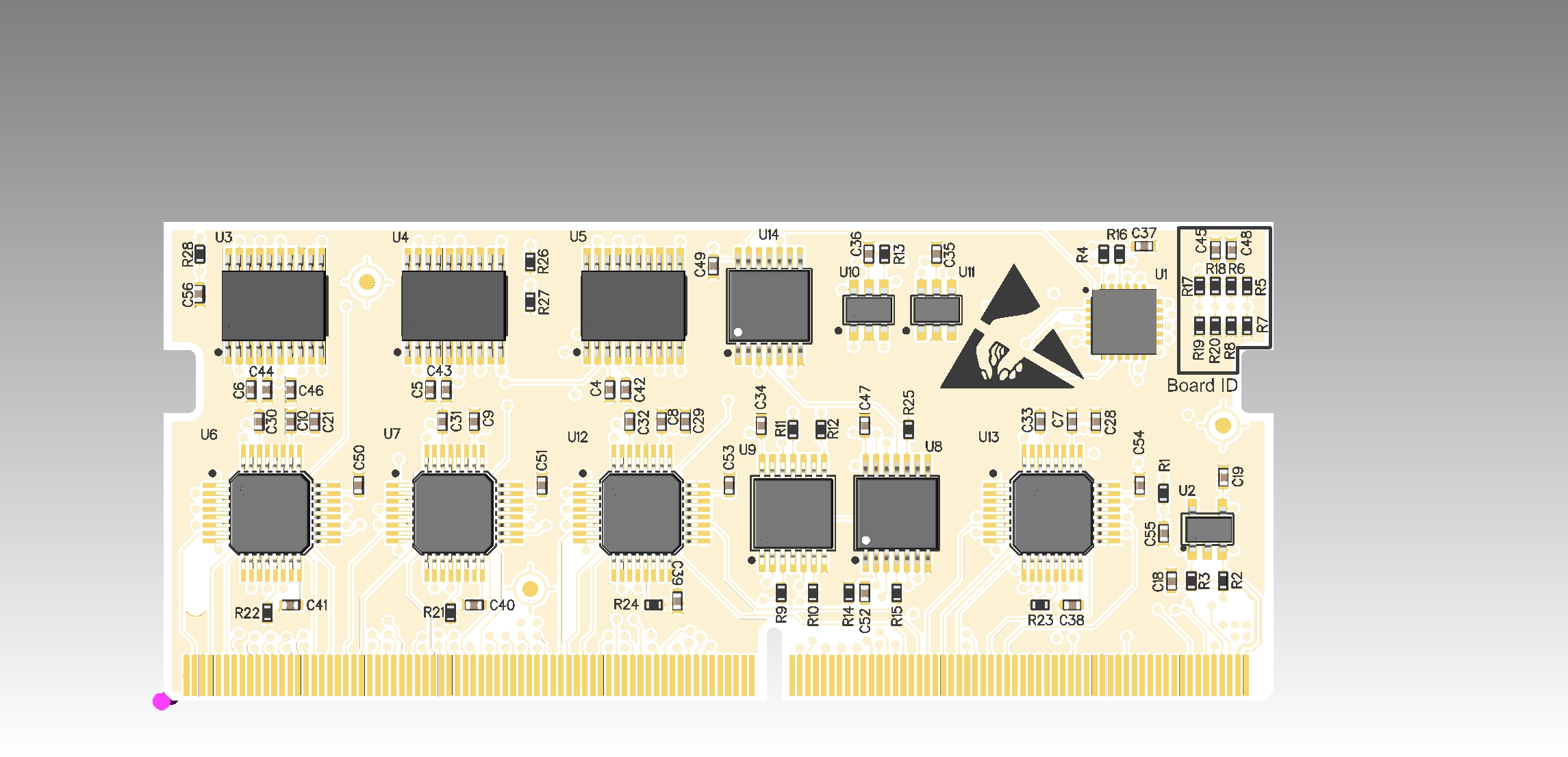
ESH10000590 is a precision analogue I/O module for Accordion systems, providing high-resolution analogue inputs and outputs intended for PCBA test, NPI, and production test environments. The module combines multi-channel ADC and DAC functionality with per-channel calibration and flexible channel modes.
Typical use cases include:
-
High-accuracy voltage measurement in PCBA and system-level test
-
Precision voltage generation for stimulus and biasing
-
Simple logic-level interfacing using pseudo-digital thresholds
-
High-speed analogue data capture using numeric result acquisition
The module is designed to be controlled entirely via software and integrated into test systems using the standard Accordion channel and API model.
Datasheet
|
Parameter |
Value |
Notes |
|
Product ID |
ESH10000590 |
|
|
Function |
Precision ADC / DAC module |
|
|
ADC channels |
12 |
Single-ended |
|
ADC resolution |
24-bit |
ADS124S08 |
|
DAC channels |
8 |
|
|
DAC resolution |
16-bit |
AD5675R |
|
ADC communication |
SPI |
Internal bus |
|
DAC communication |
I²C |
Internal bus, address 0x0C |
|
Calibration |
Gain + offset per channel |
Persistent storage |
|
Pseudo-digital mode |
ADC + DAC |
Configurable VL/VH |
|
Numeric result acquisition |
ADC only |
Multi-sample, multi-channel |
|
Calibration storage key |
Product ID, revision, serial number |
Persistent |
|
User-accessible calibration |
Yes |
Dedicated CALIBRATION channel |
-
ADC input voltage range: -2.625 V to +2.625 V (bipolar mode) or 0 V to AVDD (unipolar mode), depending on configuration and supply voltage
-
DAC output voltage range: 0 V to 2.5 V GAIN = 1 or 0 V to 5 V GAIN = 2, referenced to internal 2.5 V reference
-
Absolute accuracy / INL / DNL: Refer to ADS124S08 and AD5675R datasheets; depends on gain, reference, and configuration.
-
Max sample rate: Up to 4 kSPS per ADC ADS124S08, data-rate dependent
Manual
Software usage
Channel naming
All channels use the following naming scheme:
{ModuleIndex}.ESH10000590.{ChannelName}
Example:
0.ESH10000590.ADC05
Where ModuleIndex is the position of the module in the system.
Available user channels
-
ADC00–ADC11 – Analogue input channels
-
DAC00–DAC07 – Analogue output channels
-
CALIBRATION – Module calibration table access
All channels are user-allocatable and must be explicitly enabled before use.
Analogue mode
In analogue mode, channels behave as precision voltage inputs or outputs.
Configurable parameters:
-
Gain
-
Offset
-
Resolution (ADC)
-
Value (measured or driven voltage)
Calibration gain and offset are automatically applied in hardware.
Pseudo-digital mode
ADC and DAC channels can be configured as pseudo-digital I/O by defining voltage thresholds.
Parameters:
-
VL – Maximum voltage interpreted as logic LOW
-
VH – Minimum voltage interpreted as logic HIGH
-
MinIoVoltage – Default 0 V
-
MaxIoVoltage – Default 5 V
Rules:
-
VH must be greater than VL
-
Values between VL and VH retain the previous state (hysteresis)
In pseudo-digital output mode, the DAC drives the configured VH or VL voltage depending on logic state.
Numeric result mode (ADC only)
Numeric result channels are used for high-speed or multi-sample acquisition.
Features:
-
Configurable number of samples
-
Configurable sample rate
-
Multi-channel synchronised capture
-
Optional data reduction (min, max, average, standard deviation)
-
Base64-encoded result payload
Numeric result channels reference one or more ADC channels via TargetNetName.
Calibration handling
The CALIBRATION channel exposes the full calibration table.
-
Read returns the current calibration table as Base64
-
Write stores updated gain/offset values
Calibration data is stored persistently and automatically applied on module reset.
Error handling and validation
The module enforces:
-
Valid channel names
-
Correct direction (IN/OUT)
-
Valid VL/VH ranges
-
Enabled-channel checks for output
Misconfiguration results in explicit errors rather than undefined behaviour.
Hardware perspective
-
ADC implemented using Texas Instruments ADS124S08 (SPI)
-
DAC implemented using Analog Devices AD5675R (I²C)
-
GPIO expander PI4IOE5V6416 used for internal routing and control
All low-level bus control and routing are handled internally by the module and are not user-accessible.
Pinout
This module exposes 12 ADC channels (24 bit) and 8 DAC channels (16 bit).
|
Channel range |
Internal device |
Description |
|
MPIO00–07 |
ADS124S08 |
ADC Channels 0–7 |
|
MPIO08–15 |
AD5675R |
DAC Channels 0–7 |
|
MPIO16–19 |
ADS124S08 |
ADC Channels 8-11 |